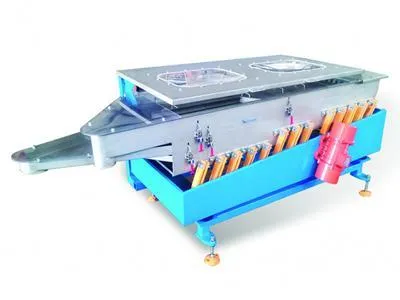
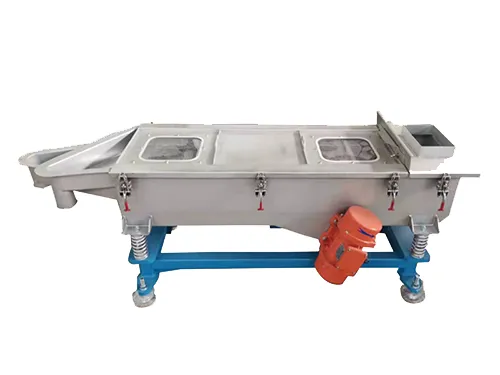
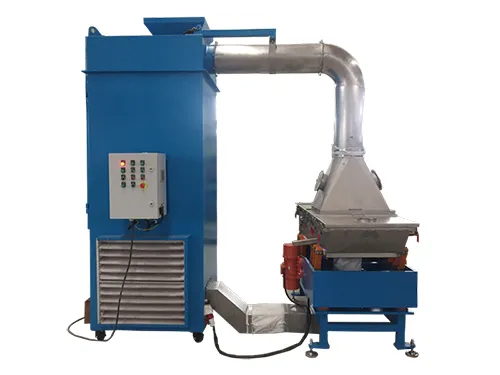
Features
- It can be quickly and completely filtered in two minutes with a sieve plate structure.
- The vibration is stable and the equipment noise is less than 65 db.
- It adopts the high excitation force low power vibration motor, and the running cost of power consumption is significantly reduced.
Applications
The vibrating pellet screener is usually positioned after the pelletizing process and before the packaging process. For the modified plastics / engineering plastics pellet production line, the vibrating pellet screener typically serves as the final quality-control step before weighing and packaging.
The common process flow of the vibrating pellet screener is: extrusion pelletizing (underwater pelletizing / air-cooled die-face pelletizing) → cooling → drying → vibrating screening → weighing and packaging
The vibrating pellet screener is suitable for extrusion-pelletized thermoplastic pellets, such as modified PA, PBT, PP, ABS, and PC.
How does a vibrating pellet screener work?
After the materials go through the feed inlet and reach the screen, they will move continuously along the screen, driven by the reciprocating vibration generated by the vibration motor.
During screening, fines, particles and small pellets pass through the screen and get separated from the wanted pellets which will keep moving along the screen and get discharged through the corresponding discharge outlet.
Long pellets, joined pellets and oversized pellets can also be screened out depending on screen mesh specifications and outfeed mechanism.
Screening is a continuous process and material residence time is not fixed, it depends on the equipment length, vibration settings, feed rate, pellet characteristics, and screening requirements.
Tags
granule separation, Natural Frequency Classifier, sieving machine